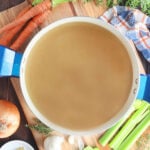
Homemade Chicken Stock
Learn how to make homemade chicken stock that's richer than store-bought! Includes stovetop, Instant Pot, slow cooker, freezing, and canning instructions.
Servings 4 quarts
Calories 18kcal
Ingredients
- 3 pounds chicken bones, as much skin removed as possible
- 2 whole carrots, cut crosswise in half
- 2 celery stalks, cleaned and cut crosswise in half
- 2 garlic cloves, peeled
- 1 onion, peeled and quartered
- 1 teaspoon whole black peppercorns
- 2 bay leaves
- 1 bundle fresh herbs (such as thyme, rosemary, sage, or oregano)
Instructions
- Place the chicken bones in a large stockpot. Add enough cold water to cover the bones by 2 to 3 inches.
- Add the vegetables, peppercorns, bay leaves, and herbs. Bring the water to a boil over medium-high heat.
- Reduce the heat to low and maintain a gentle simmer for 2 to 3 hours, skimming any foam from the surface as needed.
- Remove the pot from the heat and let the stock cool for about 1 hour.
- Using tongs or a slotted spoon, remove and discard the large bones and vegetables.
- Strain the stock through a fine-mesh sieve into a large bowl or another stockpot. Discard the remaining solids.
- Refrigerate the stock overnight.
- Remove and discard the hardened layer of fat from the surface.
- Transfer the stock to airtight containers or freezer bags for storage.
Video
Notes
- Save your chicken bones. Keep leftover bones from roasted chickens, rotisserie chickens, or baked chicken pieces in a freezer bag until you have enough to make a batch of stock.
- Don't salt the stock. Leaving out the salt makes homemade chicken stock more versatile since you can season each recipe to taste.
- Start with cold water. This helps draw more flavor and collagen from the bones, resulting in a richer stock.
- Keep the stock at a gentle simmer. Avoid a rolling boil, which can make the stock cloudy and give it a muddier flavor.
- Skim the foam. As the stock simmers, skim off any foam that rises to the surface for a clearer finished stock.
- Don't throw away the chicken fat. The hardened fat that rises to the top after chilling is called schmaltz. Save it to roast vegetables, sauté onions, fry potatoes, or add flavor to gravies.
- A jiggly stock is a good thing. If your refrigerated stock has the consistency of soft gelatin, that's a sign it's rich in natural collagen. It will return to liquid as soon as it's reheated.
- Freeze in smaller portions. Freeze stock in 1- or 2-cup portions—or even in ice cube trays—so you can thaw only what you need.
- Roast raw bones first. If you're starting with uncooked chicken bones instead of leftover roasted chicken, roast them at 425°F for 30–40 minutes for a deeper, richer flavor.
- Pressure can for long-term storage. Chicken stock is a low-acid food and must be pressure canned. Never use a water bath canner to preserve homemade chicken stock.
Nutrition
Serving: 1cup | Calories: 18kcal | Carbohydrates: 1g | Protein: 3g | Fat: 1g | Cholesterol: 8mg | Sodium: 72mg | Potassium: 115mg | Vitamin A: 425IU | Vitamin C: 1mg | Calcium: 15mg | Iron: 0.3mg
